Navigating winter weather requires a clear understanding of local municipal rules, proper equipment, and realistic timing. When planning for seasonal snow removal in St. Paul, property owners must balance city sidewalk regulations with the logistics of clearing driveways and parking lots. Managing heavy accumulation quickly keeps residential and commercial properties safe, accessible, and fully compliant throughout the cold months.
Understanding St. Paul Snow Removal Rules and Regulations
St. Paul municipal code requires property owners to clear snow and ice from public sidewalks adjacent to their land. For single-family homes and small residential buildings, snow must be removed within 24 hours after a snowfall ends. Commercial buildings and multi-family residential properties face a stricter timeline, requiring cleared sidewalks within 4 hours of daylight following a storm.
Failing to clear public walkways within the designated window can result in municipal citations and administrative fees. If a sidewalk remains covered, the city may dispatch a municipal crew to remove the snow and add the service charge directly to the property owner’s tax assessment.
Beyond municipal fines, property owners assume significant legal liability if a pedestrian suffers a slip-and-fall injury on an unmaintained public walkway.
Parking restrictions become vital during severe weather events to allow municipal plows to clear emergency routes. St. Paul declares snow emergencies with specific rules for Night Plow and Day Plow routes. Night Plow routes, marked with red signs, are plowed starting at 10:00 PM on the day an emergency is declared, and parking is prohibited on these streets until they are cleared.
Day Plow routes begin the following morning at 8:00 AM, requiring vehicles to move to cleared streets to avoid tagging and towing.
It is illegal under St. Paul city ordinance to push, blow, or shovel snow across public streets or onto neighboring private property. Depositing snow onto public roadways creates severe hazards for vehicular traffic and interferes with city plow operations. Property owners must store all accumulated snow within the boundaries of their own parcel, ensuring it does not block sightlines near driveways, public alleys, or street corners.
How Professional Snow Removal Triggers and Response Times Work
Professional clearing services operate based on predefined snow accumulation thresholds known as triggers. The standard industry options are 1-inch and 2-inch triggers, which dictate precisely when equipment dispatches to a property. Commercial accounts frequently select a 1-inch trigger to maintain continuous foot-traffic safety, while residential clients typically select a 2-inch trigger for standard driveway management.
During extended, long-duration blizzards, clearing crews do not wait until the storm completely stops to begin work. Professional operations execute preliminary “open-up” passes while snow is still actively falling. These mid-storm visits clear primary drive lanes, main building entrances, and emergency access corridors so properties remain functional and accessible during high-volume weather events.
Service providers organize work into distinct vehicular plowing and hand-shoveling routes to maximize efficiency. Standard service response windows aim to complete primary driveway plowing within 12 hours after a snowfall stops. Hand-shoveling routes for walkways, porch steps, and narrow building entries naturally require more manual labor and carry a completion goal of 24 hours post-storm.
At Peter Doran Lawn, we maintain organized routes operating with a contracted snow trigger system covering homes and commercial lots across the Twin Cities. This structured approach ensures every site receives predictable, systematic clearing standards for both minor snowfalls and major blizzard events.
Comparing St. Paul Snow Removal Pricing and Contract Structures
Calculating the cost of winter property maintenance involves much more than simply measuring total surface square footage. Pricing structures account for layout complexity, steep slopes, retaining walls, tight turnarounds, and the presence of physical obstacles. Highly intricate properties that require extensive manual edging or hand-shoveling naturally command higher service rates due to increased labor hours.
Property managers and homeowners can choose between seasonal fixed-rate contracts, per-event rates, and per-push pricing models. A seasonal fixed contract offers predictable monthly billing regardless of total snowfall, acting as financial insurance against heavy winter seasons. Per-event pricing charges a flat fee for each distinct storm, while per-push rates apply every time equipment visits the property to clear a specific accumulation tier.
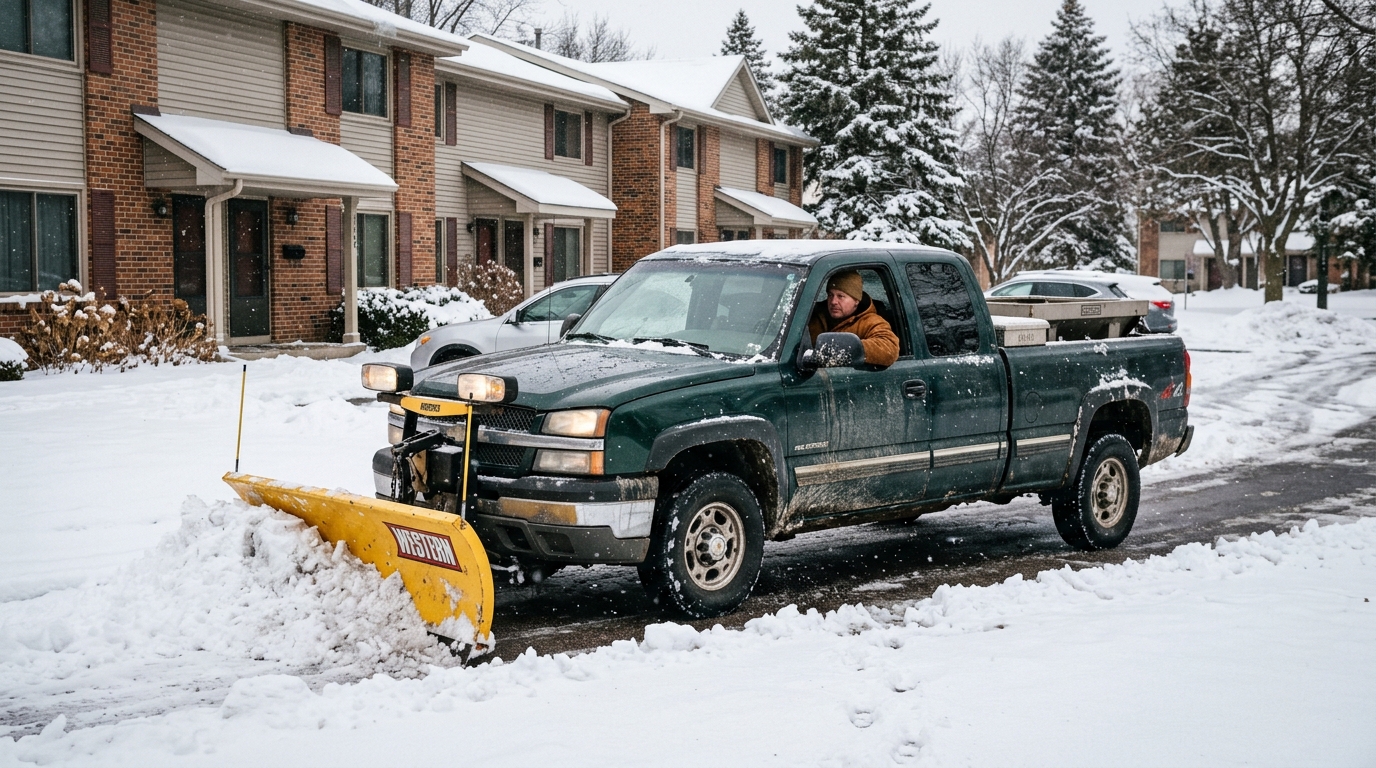
Compact urban properties, multi-family housing complexes, and congested commercial lots often cannot be serviced using standard truck-mounted plows alone. Tight parking areas with frequent vehicle presence require specialized skid steers and dedicated sidewalk snow blowers to maneuver around obstacles safely. Utilizing agile equipment prevents accidental damage to parked vehicles, curbs, landscape beds, and building facades while maintaining clean access corridors.
Our process relies on direct pricing evaluations based on site layout, required equipment, and access needs. By auditing site access points and storage locations before winter arrives, property owners can choose the contract model that best aligns with their budget and operational risks.
Preventing Winter Slip Hazards: Ice Control and Salting Services
Effective chemical deicing relies heavily on ambient temperature and surface conditions during application. Standard rock salt (sodium chloride) effectively melts surface ice down to approximately 15 degrees Fahrenheit. When temperatures drop below this threshold, professional applicators transition to specialized chemical blends, such as calcium chloride or magnesium chloride, which continue melting ice effectively at sub-zero temperatures.
Managing post-storm refreeze cycles is critical for maintaining safe pedestrian zones around building entrances and retail storefronts. Daytime solar radiation melts cleared snow banks, causing water to run across exposed concrete surfaces. As evening temperatures fall, this meltwater freezes into invisible black ice, creating severe slip-and-fall hazards that demand targeted morning salt applications.
While chemical deicers are essential for safety, improper or excessive application can cause costly long-term hardscape damage. Over-salting degrades concrete surfaces through accelerated freeze-thaw scaling and damages turfgrass along driveway edges. Utilizing calibrated broadcast spreaders ensures precise material placement, protecting adjacent vegetation while maintaining slip-free walkways.
Securing Reliable St. Paul Snow Services Before Peak Winter Storms
Enrolling in a commercial or residential service plan before the onset of peak winter weather ensures guaranteed route placement. Professional contractors cap their service capacity to maintain strict response times during severe blizzards. Property owners who wait until heavy snow falls often struggle to find available contractors, leaving their sites vulnerable to municipal fines and unsafe conditions.
Pre-season planning allows contractors to conduct thorough site audits to mark structural boundaries, landscape beds, and hidden hazards before snow covers the ground. Establishing designated snow storage locations ensures that cleared accumulation does not obscure fire hydrants, block sightlines, or restrict access to commercial dumpster enclosures. Clear communication regarding site layout prevents operational bottlenecks during high-stress winter events.
Partnering early with a professional provider eliminates the stress associated with city snow emergency declarations. Having a dedicated team assigned to your address guarantees consistent clearing schedules whenever storms disrupt normal transit. To secure complete winter maintenance coverage for your site, review our dedicated snow removal services.
Frequently Asked Questions
How much does snow removal cost in St. Paul, MN for residential driveways and commercial spaces?
Residential driveway clearing costs depend on driveway length, layout complexity, and contract type, typically ranging from per-push fees to flat seasonal rates. Commercial rates are calculated based on lot square footage, required deicing applications, and equipment needs such as skid steers or plow trucks. Obtaining a site-specific estimate ensures accurate pricing tailored to your property’s specific layout and access constraints.
Is a property owner allowed to shovel or blow snow onto adjacent private property?
No, property owners are legally required to keep all cleared snow within the boundaries of their own parcel or designated storage zones. Blowing or shoveling snow onto neighboring yards, private alleys, or public streets violates city codes and can result in civil disputes or municipal citations. Designated snow storage areas must be established on your own lot prior to the start of the winter season.
What happens during major storms when parked cars block areas that need clearing?
During major weather events, initial plowing passes clear open drive lanes and accessible parking stalls around stationary vehicles. Professional crews perform follow-up cleanup visits after parked cars leave to push back residual snow mounds and clear the remaining pavement. Establishing clear parking rotations during winter storms helps maximize total cleared surface area on multi-family and commercial sites.
How long do property owners have to shovel sidewalks in St. Paul after a snowfall?
Owners of single-family residences must clear public sidewalks adjacent to their property within 24 hours after a storm finishes falling. Commercial building owners and multi-family property managers operate under a shorter timeframe, requiring cleared walkways within 4 hours of daylight following snowfall completion. Prompt clearing prevents municipal enforcement actions and protects pedestrians from slip hazards.
What are the St. Paul snow emergency street parking rules during a storm?
When a snow emergency is declared, parking is prohibited on marked Night Plow routes beginning at 10:00 PM to allow city plows full access to major streets. Day Plow routes open for plowing the following morning at 8:00 AM, at which point vehicles must be moved to already-cleared Night routes. Violating these temporal parking restrictions results in immediate vehicle tagging and towing at the owner’s expense.
What is the difference between 1-inch and 2-inch snow plowing triggers?
A 1-inch trigger dispatches plowing equipment as soon as accumulation reaches one inch, offering high-frequency clearing ideal for commercial sites and high-foot-traffic walkways. A 2-inch trigger waits until snow reaches two inches before initiating service, making it a cost-effective option for standard residential driveways. Selecting the appropriate trigger depends on your specific mobility needs and budget tolerances.
Managing St. Paul Winter Property Maintenance Effectively
Managing winter snowfall effectively requires strict adherence to local sidewalk regulations, understanding snow emergency parking rules, and selecting the right service triggers for your site. Establishing proper snow storage areas and implementing targeted ice control protocols protects both pedestrians and surrounding landscape structures. Early planning ensures your property remains safe, clear, and fully accessible through every major winter storm.
Navigating unpredictable Minnesota winter weather demands heavy-duty equipment, experienced operators, and systematic route management. At Peter Doran Lawn, our dedicated fleet and trained crews deliver reliable plowing, snow blowing, and ice management tailored to the unique demands of local residential and commercial properties. We take the stress out of winter by ensuring your site is cleared promptly and professionally after every snowfall.
Don’t get caught unprepared during the next winter blizzard. Get a free estimate today to set up dependable service coverage and receive your free estimate.